Why do teachers choose Abu Dhabi over Dubai?
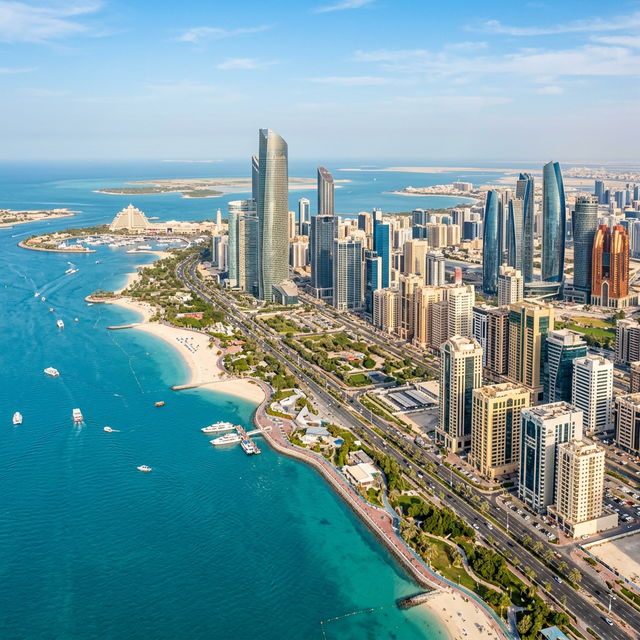
Abu Dhabi employs approximately 12,000 international teachers across 209 private schools regulated by ADEK (Abu Dhabi Department of Education and Knowledge), serving 248,000 students. The capital consistently offers 5–15% higher base salaries than Dubai for equivalent roles, mandated by ADEK’s regulatory framework that sets minimum compensation benchmarks — a teacher protection that Dubai’s KHDA does not provide.
Abu Dhabi’s appeal lies in the balance between competitive earnings and quality of life. The city is quieter and more spacious than Dubai, with wide boulevards, waterfront parks, cultural landmarks (Louvre Abu Dhabi, Qasr Al Hosn, Sheikh Zayed Grand Mosque), and access to pristine islands like Saadiyat (home to a 9 km public beach) and Yas (Ferrari World, Warner Bros World, Yas Waterworld). Teachers consistently report lower stress, better work-life balance, and stronger community bonds compared to Dubai postings.
The emirate’s education spending exceeds AED 10.5 billion annually, with ADEK investing heavily in teacher development — including mandatory 30 CPD hours per year, funded by schools. This creates well-resourced classrooms and structured professional growth paths. Return to the UAE teaching guide for country-wide context.
How much do teachers earn in Abu Dhabi in 2026?
International teachers in Abu Dhabi earn AED 11,000–27,000 per month (USD $2,995–$7,352) tax-free. ADEK’s regulatory framework ensures minimum salary standards, creating a higher floor than Dubai’s market-driven rates. Additionally, Abu Dhabi schools more frequently provide furnished accommodation rather than cash allowances, reducing initial relocation costs.
Abu Dhabi salary ranges by experience and school type
| Experience Level | Premium Schools (AED/month) | Established Schools (AED/month) | Newer/Growing Schools (AED/month) |
|---|---|---|---|
| NQT (0-2 years) | 13,000–16,000 | 11,000–14,000 | 10,000–12,000 |
| Mid-Career (3-7 years) | 17,000–22,000 | 14,000–18,000 | 12,000–15,000 |
| Senior Teacher (8+ years) | 21,000–27,000 | 17,000–22,000 | 14,000–18,000 |
| Head of Department | 24,000–30,000 | 19,000–25,000 | 16,000–21,000 |
The premium tier includes Cranleigh Abu Dhabi, Brighton College Abu Dhabi, and The British School Al Khubairat — schools charging tuition fees above AED 60,000/year. ADEK-regulated government-partnership schools (operating under PPP models) also pay competitively, with the added benefit of smaller class sizes (20–22 students vs 25–28 in Dubai). Compare across the region in our Middle East teacher salary guide.
Which are the top schools to work for in Abu Dhabi?
Cranleigh Abu Dhabi — Sister school to the prestigious 150-year-old UK boarding school. British curriculum through A-Levels, 1,200 students, Outstanding ADEK rating. Packages include furnished housing on Saadiyat Island, flights for family of 4, and tuition at 100% discount for 2 children. Staff retention of 91% — the highest in the UAE.
Brighton College Abu Dhabi — Part of the Brighton College network (UK School of the Decade). 1,800 students, stunning purpose-built campus on Al Reem Island with rooftop swimming pool. Packages exceed AED 300,000 total annual value for experienced teachers.
The British School Al Khubairat (BSK) — Abu Dhabi’s oldest British school (1968), 2,900 students, located in the embassy district. COBIS member with structured career development. Known for strong arts and sports programs with facilities including a 400-seat theatre and full-size athletics track.
Aldar Education — Abu Dhabi’s largest school operator with 30+ academies across the emirate, including Al Yasmina Academy, Al Bateen Academy, and Al Ain Academy. Offers the most entry points for new teachers, with structured training programs and clear promotion pathways from NQT to leadership within 5–7 years.
SABIS® International School Abu Dhabi — Part of the global SABIS® network, using the structured SABIS® Educational System. Data-driven instruction via AMS, comprehensive onboarding, and a clear pedagogical framework that supports teachers at every career stage. Learn about SABIS career opportunities.
What are the best neighborhoods for teachers in Abu Dhabi?

Al Reem Island — Modern high-rise island connected to downtown by bridge. Apartments from AED 3,500–6,000, with Gate Towers complex featuring retail, dining, and cinema. Walking distance to Cleveland Clinic Abu Dhabi and close to several schools. Very popular with single teachers and couples.
Saadiyat Island — Cultural district home to Louvre Abu Dhabi, NYU Abu Dhabi, and a 9 km public beach. Premium rents of AED 5,500–9,000 but exceptional lifestyle. Cranleigh Abu Dhabi and Redwood Montessori are located on-island. Popular with families seeking a resort-like lifestyle.
Khalifa City / Khalifa City A — Suburban area near ADNOC headquarters and many international schools. Villa compounds from AED 7,000–12,000 for 3–4 bedrooms with garden. Close to Masdar City, community malls, and 20 minutes from Abu Dhabi Island. Ideal for teaching families.
Al Khalidiyah / Corniche — CBD waterfront living with Corniche beach access. Apartments from AED 4,000–7,000. Walking distance to the Heritage Village, Nation Towers, and the expanding Hudayriyat Island leisure zone. Excellent for active teachers — running, cycling, and kayaking directly from home.
How does ADEK regulate teaching in Abu Dhabi?
ADEK (Abu Dhabi Department of Education and Knowledge) regulates all private schools in Abu Dhabi and Al Ain, setting standards for teaching quality, curriculum delivery, assessment practices, and — critically for teachers — minimum salary benchmarks and working conditions. ADEK inspections are rigorous and published annually, similar to KHDA in Dubai but with additional requirements.
Key ADEK requirements that benefit teachers: (1) maximum class size of 25 students per teacher, (2) minimum 30 CPD hours per year funded by the school, (3) structured induction programs for new hires, (4) transparent performance management linked to salary increments, (5) mandatory end-of-service gratuity compliance. Schools that breach ADEK standards face sanctions including enrollment caps and financial penalties.
What is the lifestyle like for teachers in Abu Dhabi?
Abu Dhabi’s lifestyle is more relaxed and family-oriented than Dubai, with lower traffic, less crowding, and a stronger sense of community. Weekend activities center on Yas Island (Ferrari World, Yas Waterworld, Warner Bros World — all offering teacher discount passes), the Corniche beach walk (8 km), desert camping at Liwa Oasis (3 hours south), and cultural experiences at Louvre Abu Dhabi and Qasr Al Watan presidential palace.
The dining scene has expanded dramatically, with Yas Marina, Al Maryah Island (The Galleria), and Saadiyat offering international cuisine. Alcohol is available in licensed hotel venues and since 2023 in licensed retail shops for residents holding a liquor license (AED 0 fee). The F1 Abu Dhabi Grand Prix (November) and UFC Fight Island events at Yas bring annual entertainment highlights.
Frequently asked questions about teaching in Abu Dhabi
Is Abu Dhabi better than Dubai for saving money?
Yes, on average. Higher base salaries (5–15%), lower rent (10–20% less for equivalent quality), and fewer lifestyle distractions mean Abu Dhabi teachers typically save AED 2,000–4,000 more per month than Dubai equivalents on the same experience level. Teachers focused on financial goals — paying off student loans, saving for a deposit, or maximizing pension contributions — often prefer Abu Dhabi. Compare in detail: Dubai vs Abu Dhabi for teachers.
Can I commute from Abu Dhabi to Dubai?
The 130 km distance takes 60–90 minutes by car via the E11 highway. While some teachers live in Abu Dhabi and commute to Dubai-border schools (Jebel Ali area), daily commuting is impractical for most. Weekend trips to Dubai are common and easy — the route takes 75 minutes in light traffic and intercity buses run every 30 minutes (AED 25 one-way).
Abu Dhabi offers the UAE’s best combination of high salaries, regulated working conditions, and a comfortable lifestyle. For teachers prioritizing financial goals and work-life balance over nightlife, the capital is the smarter choice.
Return to UAE teaching guide | Compare with Dubai, Sharjah, Al Ain
